
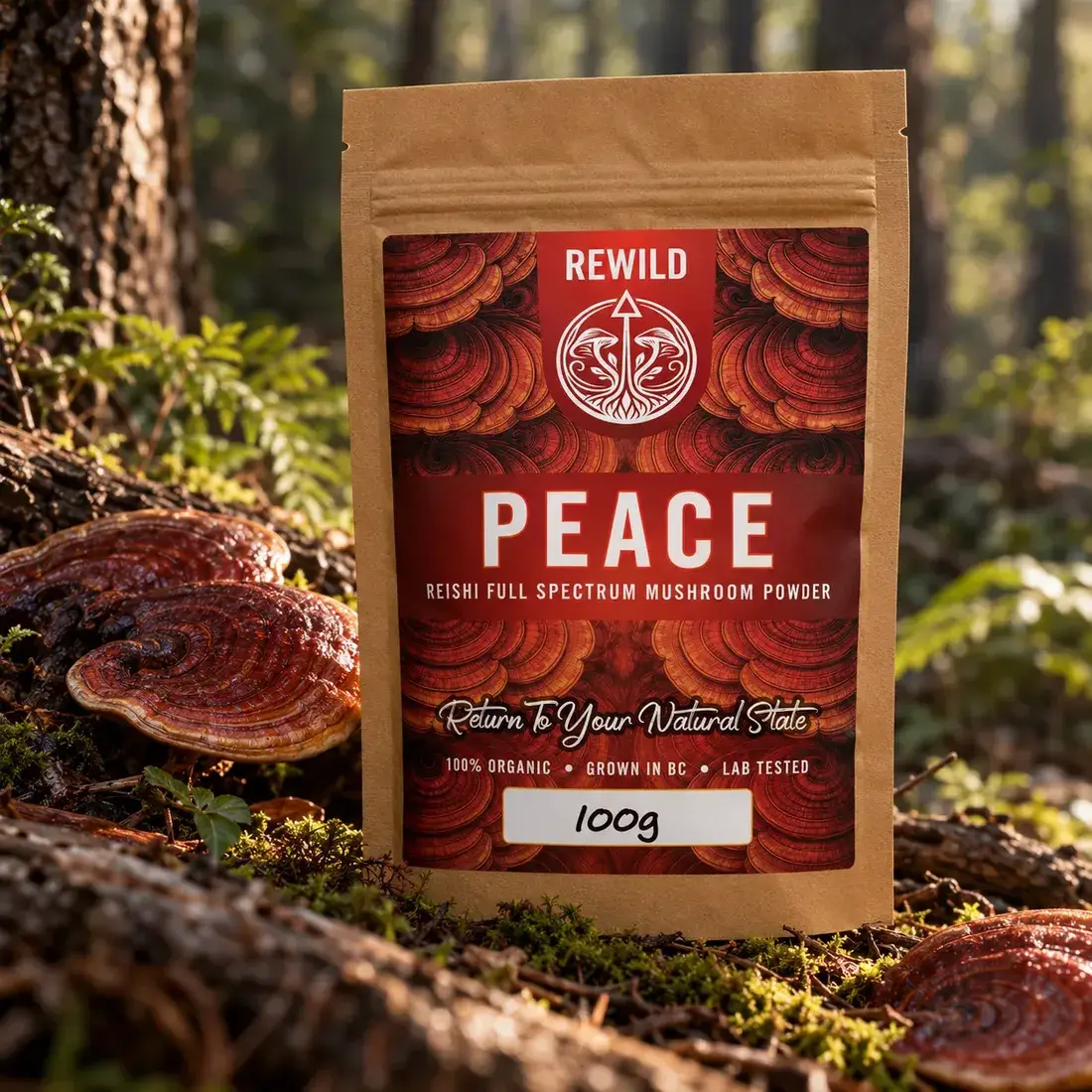
Learn · Mushroom guide
ReishiReishi mushroom (Ganoderma lucidum) guide
Ganoderma lucidum
A glossy, lacquered shelf mushroom with more than two thousand years of written history behind it.
Also called: lingzhi, varnished conk
Meet the mushroom
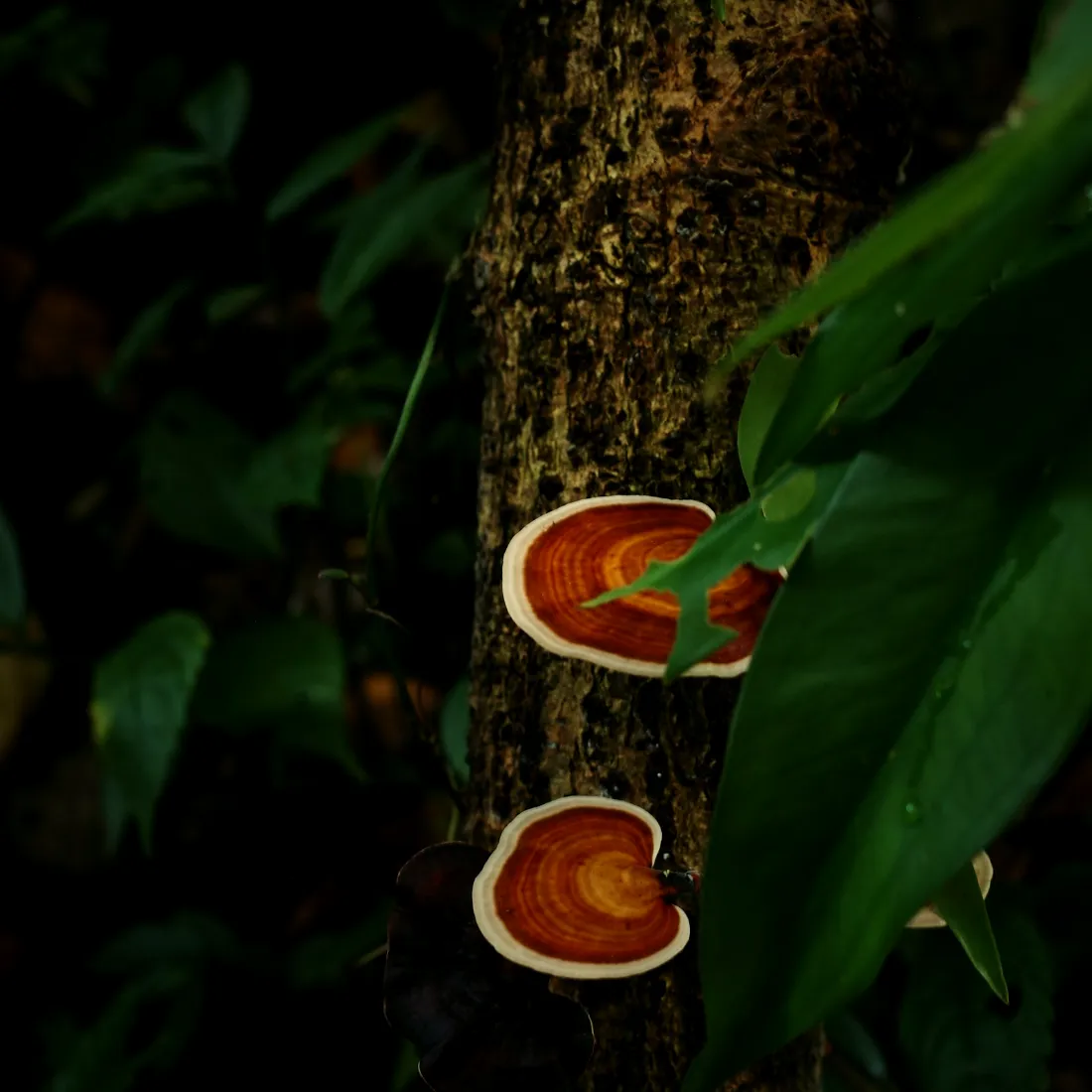
Reishi is easy to recognize once you have seen one. It grows as a woody, kidney-shaped shelf with a shiny, almost varnished top that shifts from deep red-brown in the centre to orange and creamy white at the growing edge. Flip it over and you will find tiny pores instead of gills.
It is a wood decomposer. In nature it grows on the stumps and roots of hardwood trees, slowly breaking them down and returning them to the soil. Here in the Pacific Northwest, close relatives grow on hemlock and other conifers.
Reishi is far too tough and bitter to eat like a culinary mushroom, which is why it has always been taken as a tea, a broth or a powder.
A little history
In China, Reishi is called lingzhi, and it appears in one of the oldest surviving Chinese herbal texts, written roughly two thousand years ago. Over the centuries it became a symbol of good fortune and long life, showing up in paintings, carvings and palace architecture.
Wild Reishi was once rare enough to be reserved for royalty. Cultivation changed that in the twentieth century, and today it is one of the most widely grown functional mushrooms in the world.
How ours is grown
- Grown in BC
- Cultivated indoors by our partner grower in British Columbia, using solid-state fermentation on certified organic grain.
- The whole organism
- Each powder contains the fruiting body, mycelium, stroma, natural fibre and the compounds the mycelium releases as it grows, together with the organic grain it grew on.
- DNA verified
- Every lot is identified by DNA (qPCR) and must match an authenticated reference sample of the species on the label.
- Made to last
- Water activity is kept under 0.6 so the powder stays dry and stable for three years from production.
What every lot is tested for
Release standards every lot has to meet before it ships.
| Total polysaccharides | 50% or more |
| 1,3-1,6 beta-glucans | 30% or more |
| Alpha-glucans (starch) | 10% or less |
Latest lot (250603-GL100-4215): Beta-glucans 54.4%, Total polysaccharides 57.4%. Full results
Clean by design
- Certified organic (Canada and US)
- Non-GMO
- Gluten free (under 15 ppm)
- Vegan
- Kosher
- Halal
- Made in a GMP-verified facility
- No added fillers, colours, preservatives or desiccants
Seven microbial checks on every lot: total plate count, yeast, mould, coliforms, E. coli, Salmonella and S. aureus. No pesticides are used during production.
Heavy metals
Every lot must test under these limits.
| Arsenic | under 0.1 ppm |
| Cadmium | under 0.1 ppm |
| Lead | under 0.25 ppm |
| Mercury | under 0.1 ppm |
Taste and use
What it's like.
- Colour
- Chestnut brown
- Aroma
- Herbal, toasty, earthy
- Flavour
- Bitter and bold
Reishi is the bitter one, so pair it with something rich: hot cacao, a chai, golden milk or a dark roast. Many people save it for the evening.
Go deeper
If you want to fall all the way down the rabbit hole, start with mycologist Paul Stamets. His book Mycelium Running and the 2019 documentary Fantastic Fungi are two of the best introductions to how fungi shape the living world, from forest soil to the food on your plate.
Not sure which one fits your day? Build your stack. It takes about a minute.
Or keep reading here: Cordyceps, Lion's Mane, Chaga, or the journal.
This guide is for education only and is not medical advice.
An invitation to come back.
Join the Rewilders. Field notes, new batches and lab results, a few times a month. No noise.